Your business in 360°
Consolidated financial statements: who must prepare them and how

Consolidated financial statements present a group of companies as if it were a single company: the figures of the parent and its subsidiaries are added together, while transactions within the group and intra-group balances are eliminated. In Lithuania they are governed by the Law on Reporting by Undertakings and Groups of Undertakings, in force since 1 July 2024. Below you will find who must prepare these statements, which exemptions apply, what the set comprises, how consolidation works step by step, and how to track the results of several companies throughout the year, not just at year end.
In brief
- The parent company prepares consolidated statements for the whole group, unless the group meets an exemption set out in the law, for example because it is small.
- The set comprises the consolidated balance sheet, the profit and loss statement, the cash flow statement, the statement of changes in equity and the notes.
- Consolidation is not a simple sum: you must eliminate the investment in the subsidiary, intra-group debts, internal sales and unrealised profit.
- Approved statements are filed with the Centre of Registers (Registrų centras) within 30 days of approval.
- Annual consolidation meets the legal requirements, but managers need a view of several companies every month, so it is worth automating data collection.
Contents
- What consolidated financial statements are
- When companies form a group and who must prepare the statements
- What the set of consolidated statements comprises
- How the group companies’ statements are consolidated
- Deadlines, filing and audit
- Why annual consolidation is not enough for managers
- Our view
- Multi-company analytics with Analitika360
- FAQ
- Sources
What consolidated financial statements are
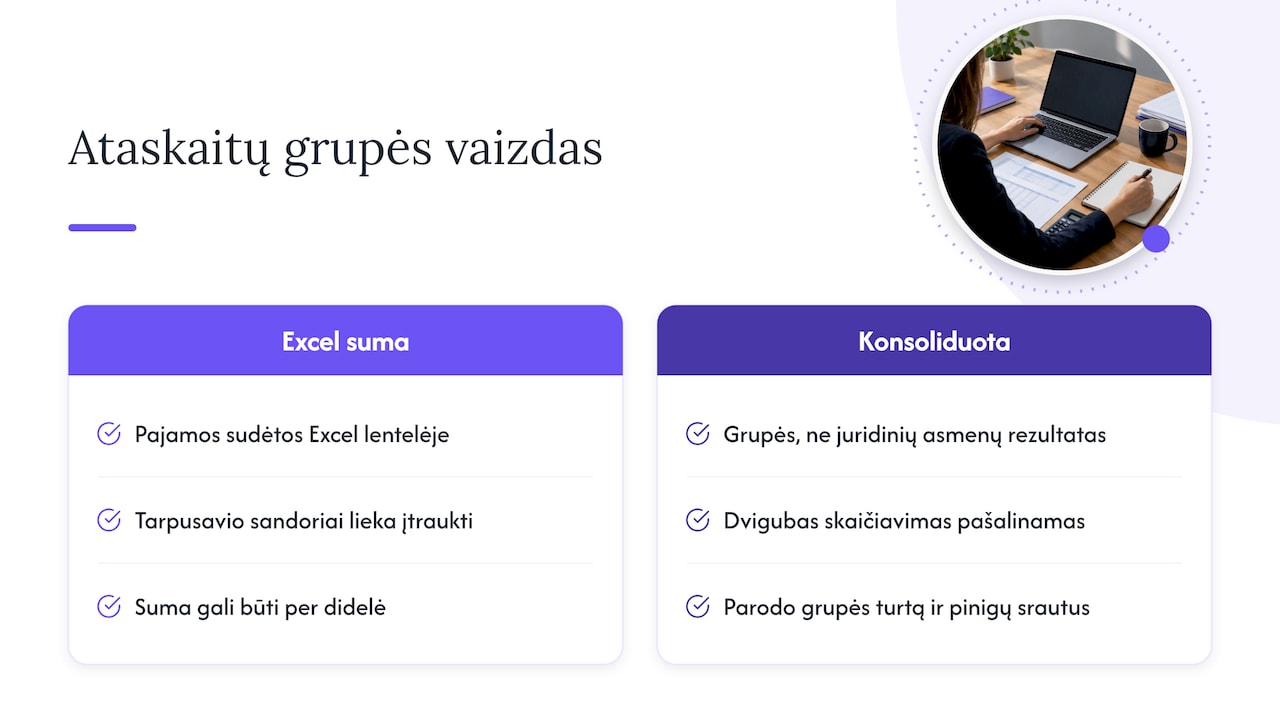
The law requires consolidated financial statements to give a true and fair view of the group’s assets, equity, liabilities, income, expenses and cash flows. In other words, the reader must see the result of the group, not of individual legal entities.
This is the essential difference between consolidated statements and simple ‘multi-company reports’. If you add up the revenue of two companies in an Excel spreadsheet, you will get a figure that is usually too high. When one group company sells goods or services to another, the same amount appears both in the seller’s revenue and in the buyer’s expenses. Seen from outside, such a transaction has created no new value for the group. Consolidation removes this double counting.
When companies form a group and who must prepare the statements
A group of undertakings consists of a parent company and the companies it controls (its subsidiaries). The obligation to prepare consolidated statements falls on the parent company.
The current Law on Reporting by Undertakings and Groups of Undertakings No XIV-2811 was adopted on 25 June 2024 and came into force on 1 July 2024. On the same day the previous Law on Consolidated Financial Reporting by Groups of Undertakings ceased to apply, so provisions quoted in older articles and seminar materials may be out of date.
When consolidated statements need not be prepared
The law provides for several exemptions:
- Small group of undertakings. The Ministry of Finance states that a small group of undertakings is not required to prepare annual consolidated financial statements.
- Immaterial subsidiaries. If a subsidiary is immaterial at group level, it may be left out.
- Long-term restrictions. Where the parent company’s rights to manage the subsidiary are significantly restricted over a long period.
- Shares acquired for resale. Where the subsidiary’s shares were acquired with the intention of disposing of them within one year.
The group’s category is determined by the group’s combined indicators: a group is small when at least 2 of the 3 indicators do not exceed the set thresholds on the parent company’s last day of the financial year. The category changes only when the thresholds are exceeded, or cease to be exceeded, for 2 consecutive financial years, so a single strong year is not enough to trigger the obligation to consolidate.
Before deciding to use an exemption, check the asset, revenue and headcount thresholds in the current version of the law and discuss your situation with your auditor. Even where the law does not require consolidation, a bank, an investor or a buyer assessing an acquisition of the group may ask for precisely a consolidated view.
What the set of consolidated statements comprises
Under the law, the set consists of five parts:
| Statement | What it shows |
|---|---|
| Consolidated balance sheet | The group’s assets, equity and liabilities at the end of the financial year, excluding intra-group debts |
| Consolidated profit and loss statement | The group’s income, expenses and profit, excluding internal sales |
| Consolidated cash flow statement | Cash movements between the group and the outside world, excluding internal transfers |
| Consolidated statement of changes in equity | How the group’s equity changed during the year |
| Notes | Accounting policies, group structure, details of material items |
Where the law requires it, a consolidated management report is filed with the Centre of Registers alongside the set. The statements themselves are prepared under the Business Accounting Standards (VAS), with consolidation governed by VAS 16, or under International Financial Reporting Standards, depending on the company.
How the group companies’ statements are consolidated
The consolidation process can be broken down into clear steps. The Authority of Audit, Accounting, Property Valuation and Insolvency Management’s methodological recommendations on VAS 16 illustrate each of them with numerical examples.
- Define the boundaries of the group. Draw up a list of the companies the parent controls and note the percentage of shares held.
- Align the period and accounting policies. Data for the same reporting period are consolidated. If group companies’ financial years end at different times, the difference may not exceed 3 months. Accounting principles for inventory, depreciation and other items must be uniform.
- Combine the statements line by line. Assets, liabilities, equity, income and expenses are added together.
- Eliminate the investment. The value of the investment in the subsidiary carried in the parent’s balance sheet is offset against the corresponding share of the subsidiary’s equity.
- Eliminate intra-group balances and transactions. Intra-group receivables and payables, internal sales and purchases, loans and interest, and dividends are removed.
- Remove unrealised profit. If a group company has not yet sold to external customers goods it bought from another group company, the internal mark-up included in their value has not yet been earned by the group.
- Show the non-controlling interest. Where the parent does not hold all the shares, the share of equity and profit attributable to other shareholders is shown separately.
- Prepare the notes and check. Make sure intra-group amounts match on both sides. This is where errors most often occur.
Example: two companies, one internal transaction
Suppose UAB ‘A’ holds 100% of the shares in UAB ‘B’. During the year, ‘A’ sold goods worth €100,000 to ‘B’, and ‘B’ sold all of them on to external customers. At year end, ‘B’ still owes ‘A’ €30,000. The figures are invented for illustration.
| Item | UAB ‘A’ | UAB ‘B’ | Elimination | Group |
|---|---|---|---|---|
| Revenue | €800,000 | €300,000 | −€100,000 | €1,000,000 |
| Cost of sales | €600,000 | €250,000 | −€100,000 | €750,000 |
| Gross profit | €200,000 | €50,000 | €0 | €250,000 |
| Receivables | €30,000 | €0 | −€30,000 | €0 |
| Payables | €0 | €30,000 | −€30,000 | €0 |
A simple sum would put revenue at €1,100,000, even though the group received €1,000,000 from external customers. Profit does not change after elimination because all the goods were sold. If at year end ‘B’ still had goods from ‘A’ worth €20,000 in its warehouse, and ‘A”s mark-up were 25% of the selling price, the group’s inventory and profit would be reduced by €5,000 of unrealised profit.
Deadlines, filing and audit
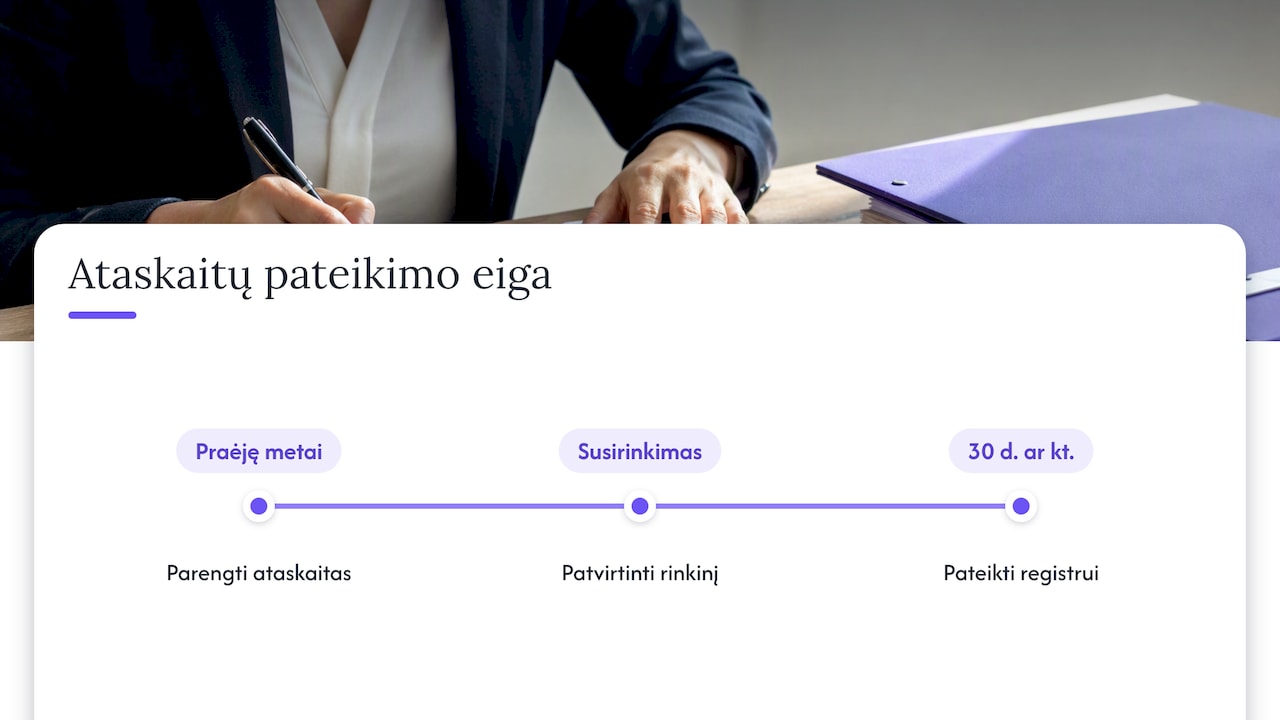
Consolidated statements are prepared for the previous financial year and approved at the annual general meeting of members. The approved set is filed with the Register of Legal Entities within 30 days of approval, unless the law sets a different deadline. Which documents to file and in what format (XHTML or PDF) is set out in the Centre of Registers’ filing procedure.
An audit is mandatory for public-interest entities and other legal entities specified in the law, including those where at least 2 indicators exceed the set thresholds. If the group has an audit committee, it also oversees the audit of the consolidated statements. In practice, this means the consolidation working papers (elimination entries, reconciliations of intra-group balances) must be orderly and traceable.
Why annual consolidation is not enough for managers
The law requires a consolidated view once a year. But a group’s manager, finance director or owner makes decisions every week: where to direct cash, which company is loss-making, whether internal sales are distorting profitability. If the finance department collects the results of several companies by hand each month from different accounting databases and Excel files, the report runs several days late and the risk of error grows with every copy.
The solution usually has three parts:
- A single data model. The charts of accounts of all the companies are mapped to a common structure, and intra-group counterparties are flagged so they can be separated automatically. We describe how to build such a model in our article on the data model for finance.
- Automatic refresh. Data are taken from the accounting software without manual exports. The more processes are joined up in one system, the easier it is to pull data automatically: this is one of the main advantages of an ERP system.
- Clear indicators. Group revenue, margins, debts and cash flows by company and combined. You will find examples of indicators in our guide to KPIs for finance, and we discussed the structure of management reports in our article on CFO reports.
Our view
We work every day with companies whose accounts are kept in Rivilė and Finvalda, and we see the same pattern: official consolidation is carried out once a year, and for the remaining eleven months managers see the group only in pieces. We believe this is the biggest missed opportunity.
Statutory consolidated statements remain the responsibility of the accountant and the auditor, and so they should. At management level, however, a view across several companies can be available all the time. When data from accounting software, SharePoint, Excel or a CRM are brought together in a single Power BI model and refresh automatically, the finance team stops hunting for where the difference between two spreadsheets ‘went’ and spends its time on analysis instead. A well-organised management model also makes official consolidation easier at year end: the intra-group balances are already reconciled.
— Analitika360
Multi-company analytics with Analitika360
Analitika360 offers ready-built Power BI report packages for Rivilė and Finvalda users: the Basic plan costs €59 a month and the PRO plan €89 a month. Revenue, expenses, profit, the balance sheet, sales and debts refresh without any extra work. If your group needs to combine data from several companies or several systems around its own processes, we deliver bespoke projects at €70 an hour. You can compare plans and terms on our business analytics pricing page.
FAQ
Are consolidated statements the same as the sum of several companies’ statements?
No. A simple sum includes intra-group sales, debts and investments, and so inflates revenue, assets and liabilities. In consolidated statements these amounts are eliminated so that only transactions with external parties remain.
Can a small group of undertakings skip consolidated statements?
Yes, under the law a small group of undertakings is not required to prepare annual consolidated financial statements. A group is considered small when at least 2 of the 3 combined indicators do not exceed the set thresholds. Check the thresholds in the current version of the law and discuss them with your auditor.
By when must consolidated statements be filed with the Centre of Registers?
The approved set is filed within 30 days of its approval at the general meeting of members, unless the law sets a different deadline. The statements are prepared for the previous financial year.
Can Power BI prepare official consolidated statements?
Power BI is a management analytics tool: it lets you see the indicators of the group and of individual companies at all times and makes reconciling intra-group balances easier. The official set, its elimination entries and the notes are prepared by, and are the responsibility of, the company’s accounting department and, where required, are checked by the auditor.
Sources
- Law of the Republic of Lithuania on Reporting by Undertakings and Groups of Undertakings No XIV-2811 (e-TAR)
- Law on Consolidated Financial Reporting by Groups of Undertakings No IX-576 (e-seimas)
- Ministry of Finance: financial reporting by undertakings
- Teisės aktų gidas: new version of the law from 1 July 2024
- Centre of Registers: guidance note
- Authority of Audit, Accounting, Property Valuation and Insolvency Management: VAS 16 methodological recommendations
- Centre of Registers: filing deadlines for financial statements
- Centre of Registers: filing procedure for financial statements
- AVNT: frequently asked questions